

Orthopedic Implants Market to reach USD 103.05 Billion by 2035 at 4.96% CAGR
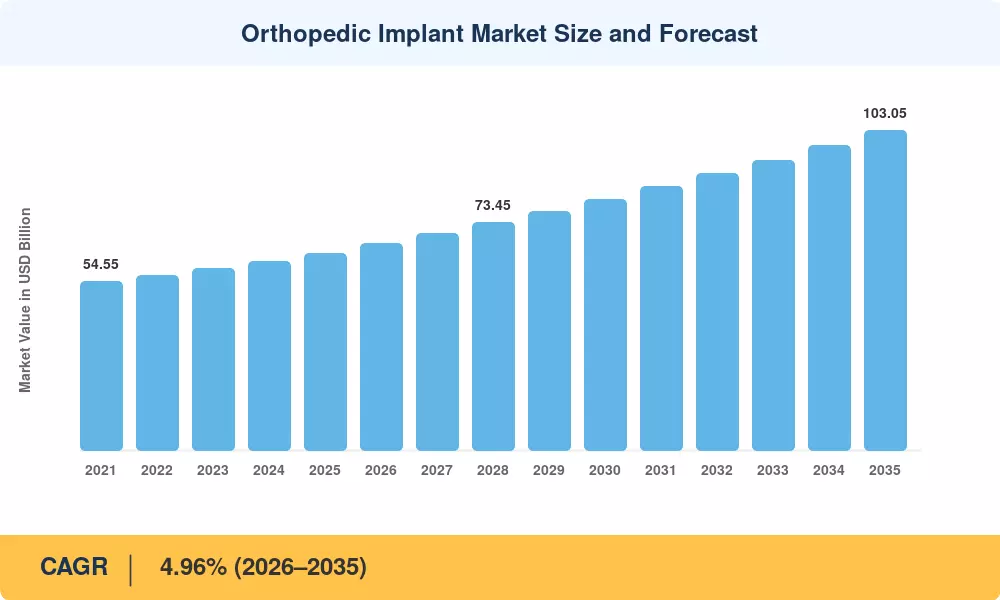
Orthopedic Implants Industry Size
Orthopedic Implants Market to Grow from USD 66.65 Billion in 2026 to USD 103.05 Billion by 2035— Powered by Aging Demographics and Osteoarthritis Prevalence
NY, CA, UNITED STATES, July 20, 2026 /EINPresswire.com/ -- As per Market Research Future, the global Orthopedic Implants Market size is projected to reach USD 103.05 Billion by 2035 from USD 66.65 Billion in 2026, at a CAGR of 4.96% during the forecast period 2026–2035. The market base was estimated at USD 63.50 Billion in 2025.The 4.96% CAGR—anchored by structural demographic demand rather than discretionary healthcare spending—is driven by three converging forces: aging demographics across developed economies that continue to widen the addressable base for joint replacement and spinal procedures, sustained robotic-assisted surgical platform expansion that has pulled conventional cemented and uncemented implants toward AI-enabled pre-operative planning and 3-D printed patient-specific devices, and the technological shift from inpatient-only joint replacement toward ambulatory surgical center migration that compresses per-procedure facility costs by 30–40% while maintaining comparable 90-day readmission rates.
National governments and multilateral health organizations are amplifying this momentum. The WHO estimates that the global population aged 60+ will double to 2.1 billion by 2050, while The Lancet's 2023 Global Burden of Disease update reports that worldwide, more than 500 million people already have osteoarthritis, with incidence rising dramatically after age 55. The U.S. Centers for Medicare & Medicaid Services removed total knee arthroplasty from its inpatient-only list in 2018, and total hip arthroplasty followed in 2020, converting a hospital-dominated market into one with a structural outpatient tail. China's volume-based procurement (VBP) program has reduced domestic implant prices by 50–80% but tripled procedure volumes in covered provinces between 2021 and 2024. India's Ayushman Bharat policy now covers joint replacement for 500 million beneficiaries, with over 120,000 publicly funded arthroplasties performed in FY 2024, a 45% increase year-over-year. Together, these initiatives are creating the procurement infrastructure and surgical innovation ecosystem on which the Orthopedic Implants Market depends.
Request A Free Sample:
https://www.marketresearchfuture.com/sample_request/838
Key Market Trends & Growth Drivers
Aging Demographics and Rising Osteoarthritis Prevalence
According to the UN, by 2050, 16% of the world's population will be aged 65 and above, up from 10% in 2022. The Lancet's 2023 Global Burden of Disease update reports that worldwide, more than 500 million people already have osteoarthritis, with incidence rising dramatically after age 55. 2.5–3.0% of the growth in demand for knee and hip replacement is expected to be driven by the 65+ cohort with a 1 percentage-point increase. This is a compounding tailwind for the Orthopedic Implants Market throughout the projection horizon. Each percentage point of aging-population growth translates into measurable implant volume, and the osteoarthritis burden embedded in routine geriatric care makes this driver structurally durable through 2035.
Cementless fixation technologies have gained significant ground: in the US, cementless total knee arthroplasty rose from 8% to 22% of primary procedures between 2018 and 2024, according to the American Joint Replacement Registry. The sub-segment benefits from predictable demographic demand and well-established clinical pathways.
Robotic-Assisted Surgical Platform Expansion
Robotic orthopedic surgery has crossed the early-adopter threshold. By 2025, approximately 12% of total knee arthroplasties in the United States were performed on robotic platforms, up from under 3% in 2018. Capital expenditure commitments from large hospital systems signal that penetration will reach 25–30% by 2030. Stryker's Mako platform surpassed 2,500 cumulative system placements globally by mid-2025, while the FDA cleared more than 180 3-D printed orthopedic devices between 2020 and 2025. These advances compress operating times, improve alignment accuracy, and reduce revision rates—all of which strengthen the long-term value proposition of the Orthopedic Implants Market.
Robotic systems command a 15–20% premium on implant-procedure bundles, directly expanding the revenue opportunity within the Orthopedic Implants Market. Hospitals investing USD 1.0–1.5 million in a robotic system typically commit to that vendor's implant portfolio for 5–7 years, creating a captive-implant ecosystem that converts a one-time capital sale into a recurring consumables stream, increasing lifetime customer value 3–4×. Pooled procurement through group purchasing organizations drives per-unit prices down in high-volume tiers, expanding access while compressing manufacturer margins.
Ambulatory Surgical Center Migration
CMS removed total knee arthroplasty from its inpatient-only list in 2018, and total hip arthroplasty followed in 2020. ASCs now perform an estimated 18% of primary hip and knee replacements in the United States, a figure expected to exceed 35% by 2030. The shift reduces per-procedure facility costs by 30–40% while maintaining comparable 90-day readmission rates, making ASCs an attractive channel for both payors and device manufacturers competing in the Orthopedic Implants Market.
Registry data from over 45,000 ASC-based arthroplasties shows 90-day readmission rates comparable to inpatient settings at 2.1% versus 2.4%. Proper patient selection remains critical for safe discharge. ASC-optimized implant portfolios, including rapid-recovery equipment and disposable single-use trays, represent a high-growth product development opportunity. Manufacturers that co-develop implant-plus-logistics bundles with top ASC chains may gain first-mover advantage in a channel projected to account for over 35% of U.S. joint volume by 2030. As per-procedure costs fall with scale and payer models evolve, the addressable channel widens from high-end tertiary hospitals to community ASCs and specialty clinics, extending orthopedic implant access beyond traditional settings.
Ask for Customization:
https://www.marketresearchfuture.com/ask_for_customize/838
Market Segment Insights
BY PRODUCT TYPE
Joint Replacement Implants: Dominant segment with ~38.4% revenue share in 2025. Driven by approximately 2.5 million hip and knee arthroplasties performed each year globally. Cementless fixation technologies have gained significant ground, with cementless total knee arthroplasty rising from 8% to 22% of primary procedures in the US between 2018 and 2024. Johnson & Johnson (DePuy Synthes) and Stryker anchor this segment.
Spinal Implants: USD 11.05 Billion in 2025. Minimally invasive transforaminal lumbar interbody fusion (MIS-TLIF) procedures have grown at roughly 12% annually since 2020, shifting demand toward smaller-footprint cages and percutaneous pedicle-screw systems. Medtronic and Globus Medical lead expansion.
Trauma Fixation Devices: ~16.2% share in 2025. Road-traffic injuries and fragility fractures sustain demand across emergency and orthopedic trauma settings.
Orthobiologics: Fastest-growing product category at 10.93% CAGR (2026–2035). Fueled by regenerative medicine adoption in sports orthopedics. Bone graft substitutes, platelet-rich plasma, and stem cell concentrates represent a rapidly expanding addressable base.
Sports Medicine Devices: Growing at 5.18% CAGR. Rising recreational sports participation drives demand for soft-tissue fixation and arthroscopic repair devices.
BY TECHNOLOGY
Conventional Implants: Dominant technology with ~51.2% share in 2025. Established clinical track record and cost efficiency sustain volume leadership across mature markets.
Robotic-Assisted & Navigation Systems: Fastest-growing technology class at 10.53% CAGR (2026–2035). Driven by hospital capital investment cycles and measurable improvements in alignment accuracy and revision-rate reduction. Stryker's Mako and Zimmer Biomet's ROSA anchor this segment.
3-D Printed Patient-Specific Implants: Growing at 8.14% CAGR. Custom-fit advantages and complex reconstruction applications drive adoption as titanium powder costs decline and printer throughput improves.
BY BIOMATERIAL
Metallic: Dominant biomaterial with ~52.8% share in 2025. Titanium alloy and cobalt-chromium-molybdenum constitute 40–50% of implant manufacturing costs, anchoring structural demand across joint and spinal applications.
Ceramic: Fastest-growing biomaterial at 6.2% CAGR (2026–2035). Alumina, zirconia, and oxidized zirconium demonstrate superior wear characteristics in hip bearings, driving premium adoption.
Polymeric: USD 4.12 Billion in 2025. PEEK spinal implants and ultra-high molecular weight polyethylene (UHMWPE) bearings serve specialized load-bearing and motion-preservation applications.
Others: Growing at 5.1% CAGR. Biodegradable magnesium-based and poly-L-lactic acid resorbable fixation devices are gaining traction in pediatric and sports-medicine segments.
BY END USER
Hospitals: Dominant end user with ~59.0% share in 2025. Complex revision cases, multi-level spine fusions, and polytrauma sustain volume leadership through inpatient infrastructure.
Ambulatory Surgical Centers: Fastest-growing end-user segment at 9.49% CAGR (2026–2035). CMS outpatient designation, cost efficiency, and clinical evidence supporting same-day discharge for primary hip and knee arthroplasty accelerate ASC migration.
Specialty Clinics: USD 7.44 Billion in 2025. Focused orthopedic practices and sports medicine centers drive demand for specialized implant portfolios.
Others: Growing at 3.8% CAGR. Rehabilitation centers and military facilities represent incremental demand channels.
Read Detailed Insights:
https://www.marketresearchfuture.com/reports/orthopedic-implant-market-838
Regional Outlook
North America — Dominant Market (~45.6% Share, 2025)
The United States generates approximately 82.3% of North American Orthopedic Implants Market revenue, driven by Medicare/CMS policy, robotic platform installations, and the highest per-capita procedural volumes globally. CMS's decision to shift total joint procedures into the outpatient setting has unlocked a multi-billion-dollar ASC opportunity, while commercial payors invest in value-based orthopedic bundles. Reimbursement breadth and bundled payment infrastructure support premium-priced robotic and 3-D printed implant demand that emerging-market regions cannot match.
Canada contributes through provincial orthopedic wait-list reduction programs at 10.8% of regional share, with CAD 1.4 billion allocated in 2024–2025 to reduce surgical wait times that ballooned during COVID, directly boosting implant procurement volumes. Mexico contributes USD 0.44 Billion on medical-tourism growth and IMSS coverage expansion, representing the region's highest-growth opportunity. North America's leadership rests on procedural density, reimbursement depth, and the structural shift toward ASC-based joint replacement.
Europe — Second Largest (~26.8% Share, 2025)
Europe's Orthopedic Implants Market reflects divergent national strategies under a harmonizing regulatory umbrella. Germany anchors regional demand with 5.12% CAGR, driven by high arthroplasty volumes—approximately 450,000 joint replacements annually—and DRG reimbursement reform. The UK contributes USD 3.12 Billion on the NHS Long-Term Plan committed GBP 8 billion to elective-care recovery through 2025, prioritizing hip and knee replacements as the highest-volume surgical backlog category.
France is growing at 4.78% CAGR on an innovation-friendly HAS assessment framework. Italy contributes USD 2.14 Billion on public-tender consolidation. Spain is growing at 4.65% CAGR on a growing elderly population share. The Nordic countries contribute USD 1.72 Billion on national joint-replacement registries that drive quality benchmarking. Harmonization pressure from the EU Medical Device Regulation (MDR)—which has delayed or withdrawn an estimated 25–30% of orthopedic SKUs from the European market due to constrained notified-body capacity—is gradually narrowing national differences, lifting baseline demand across the region. Russia is growing at 4.41% CAGR on import-substitution policy for domestic implant manufacturing. The rest of Europe contributes USD 2.34 Billion on mixed regulatory maturity across accession states.
Asia-Pacific — Fastest-Growing Region (9.38% CAGR, 2026–2035)
Asia-Pacific is the engine of the Orthopedic Implants Market. China holds the largest regional share at 38.2%, with the volume-based procurement (VBP) program reducing domestic implant prices by 50–80% but tripling procedure volumes in covered provinces between 2021 and 2024. India is growing at 10.64% CAGR on Ayushman Bharat coverage for 500 million beneficiaries, with over 120,000 publicly funded arthroplasties performed in FY 2024, a 45% increase year-over-year.
Japan contributes USD 4.55 Billion on super-aging society and robotic surgery adoption. South Korea is growing at 9.42% CAGR on national health insurance orthopedic coverage expansion. ASEAN economies contribute USD 1.88 Billion on medical-tourism hubs in Thailand and Singapore. The rest of Asia-Pacific is growing at 8.15% CAGR on infrastructure investment across emerging systems. The region's combined contribution anchors the global volume base for joint replacement, spinal fusion, and trauma fixation demand.
Middle East & Africa — Emerging Opportunity (USD 2.79 Billion, 2025)
The Middle East & Africa carries the widest orthopedic infrastructure gap and therefore significant opportunity. Saudi Arabia leads the region with 32.5% share, with Vision 2030 targeting a 50% increase in hospital bed capacity by 2030, with orthopedic centers of excellence in Riyadh and Jeddah as priority projects. The UAE is growing at 5.94% CAGR on medical tourism and private-hospital expansion, attracting patients from across the GCC and South Asia.
South Africa contributes USD 0.48 Billion as the largest sub-Saharan implant market. Egypt is growing at 6.12% CAGR on population scale and growing orthopedic surgeon workforce. The rest of MEA contributes USD 0.67 Billion on NGO-funded trauma surgery programs. Raw-material and supply-chain volatility remains a restraint—titanium sponge prices rose 22% between 2022 and 2024, driven by aerospace demand competition and Russian export disruptions, forcing manufacturers to carry higher safety stock. Leasing models and vendor-managed inventory programs are unlocking incremental access.
Competitive Landscape and Recent Developments
The Orthopedic Implants Market exhibits medium concentration, with an estimated Herfindahl-Hirschman Index in the 1,200–1,500 range and the top five players collectively holding an estimated 55–62% of global revenue. Competitive intensity centers on robotic platform lock-in, 3-D printing capabilities, and ASC channel partnerships. Concentration is highest in high-income segments where regulatory and manufacturing barriers are steep; the emerging-market tier is more fragmented as regional producers compete on price.
The competitive landscape is stratified between full-spectrum joint reconstruction leaders serving hospital and DSO markets, spine-focused robotics specialists capturing minimally invasive fusion growth, and orthobiologics innovators consolidating the regenerative medicine segment.
KEY COMPANIES AND RECENT MILESTONES
Johnson & Johnson (DePuy Synthes) (2024–2025): Maintains leadership with ATTUNE knee, PINNACLE hip, and VELYS robotic system, commanding ~15–18% of global Orthopedic Implants Market revenue. Full-portfolio leader with robotic integration and broadest global distribution.
Stryker Corporation (February 2024): Received FDA 510(k) clearance for the Mako Total Shoulder application, expanding the robotic platform's addressable procedure volume into upper-extremity arthroplasty. Mako robotic platform, Triathlon knee, and Accolade hip anchor a robotic-ecosystem strategy. Estimated revenue share: ~13–16%.
Zimmer Biomet Holdings (2024–2025): ROSA robotics, Persona knee, and mymobility digital platform anchor digital care management and personalized implants. The Persona IQ smart knee implant is the world's first sensor-enabled joint replacement. Estimated revenue share: ~10–13%.
Medtronic plc (2024–2025): Mazor X spine robotics, INFUSE bone graft, and Solera spine anchor spine-focused positioning with AI-assisted navigation. Estimated revenue share: ~7–9%.
Future Outlook: 2026–2035
By 2030, AI-enabled surgical planning and navigation will become the operating system of orthopedic implant delivery. Machine-learning algorithms trained on millions of CT and MRI datasets are already delivering sub-millimeter implant sizing and positioning recommendations, reducing outlier alignment rates by 30–40% in early clinical trials. By 2030, AI-integrated planning platforms will become standard procurement criteria for hospitals evaluating the Orthopedic Implants Market.
Real-time intraoperative guidance creates a data asset that manufacturers can monetize through subscription-based software updates and outcomes benchmarking services, creating a new business model layered on top of the core implant franchise.
More Related Research Insights:
https://www.marketresearchfuture.com/reports/healthcare-training-and-education-services-outsourcing-market-32023
https://www.marketresearchfuture.com/reports/hemoglobinopathies-treatment-market-42611
https://www.marketresearchfuture.com/reports/hemostasis-diagnostic-market-42623
https://www.marketresearchfuture.com/reports/herpes-zoster-infection-treatment-market-42624
https://www.marketresearchfuture.com/reports/hip-replacement-market-42952
https://www.marketresearchfuture.com/reports/hodgkins-lymphoma-treatment-market-42758
https://www.marketresearchfuture.com/reports/home-sleep-apnea-test-market-41131
https://www.marketresearchfuture.com/reports/human-insulin-drug-market-42945
https://www.marketresearchfuture.com/reports/human-placental-protein-market-42751
https://www.marketresearchfuture.com/reports/hydroxychloroquine-drug-market-42937
Larry Wilson
WantStats Research And Media Pvt. Ltd.
+1 855-661-4441
email us here
Visit us on social media:
LinkedIn
Facebook
YouTube
X
Legal Disclaimer:
EIN Presswire provides this news content "as is" without warranty of any kind. We do not accept any responsibility or liability for the accuracy, content, images, videos, licenses, completeness, legality, or reliability of the information contained in this article. If you have any complaints or copyright issues related to this article, kindly contact the author above.
